

The Sawdust
Like Venice, Seattle was established on a saltwater lagoon. Instead of building canals, Seattle filled her lagoon with sawdust from Henry Yesler's sawmill.

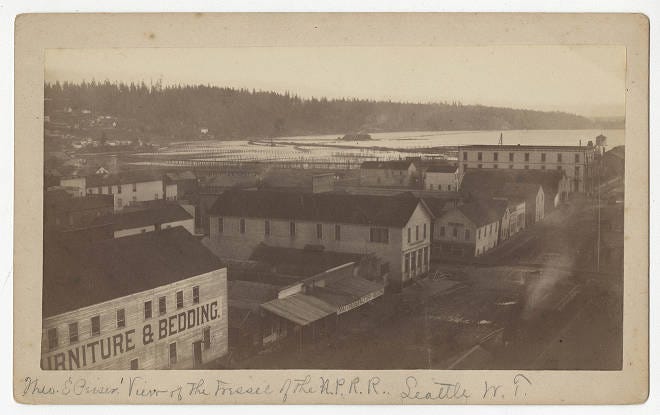
Fabulous 1884 Theodore Peiser photograph looking southeast across what originally was a saltwater lagoon when Seattle was established in 1852, from the roof of the Occidental Hotel at James Street and Yesler Way, site of today’s Sinking Ship parking garage.
At my Pioneer Square history walk this coming Saturday, July 25, I will talk at length about how a saltwater lagoon came to be filled in with sawdust from Henry Yesler’s sawmill, and rightfully came to be known as the capital “S” Sawdust, basically pioneer Seattle’s low-rent district.
I discovered this wonderful photograph of the Sawdust in the University of Washington’s digital collections after I published my new book, Seattle Pioneer Square History Walk, which is why the photograph does not appear in my book. If I ever publish a second edition, this photograph will be included.
The long white two-story building at the center of the photograph was the Oriental Hotel, at the intersection of today’s Occidental Avenue (originally Second Street) and Washington Street. Every building visible in this photograph was destroyed by the Great Seattle Fire of June 6, 1889. Because sawdust does not create a particularly stable building foundation, the first buildings constructed on the Sawdust were built on pilings and stilts sunk into the former lagoon.
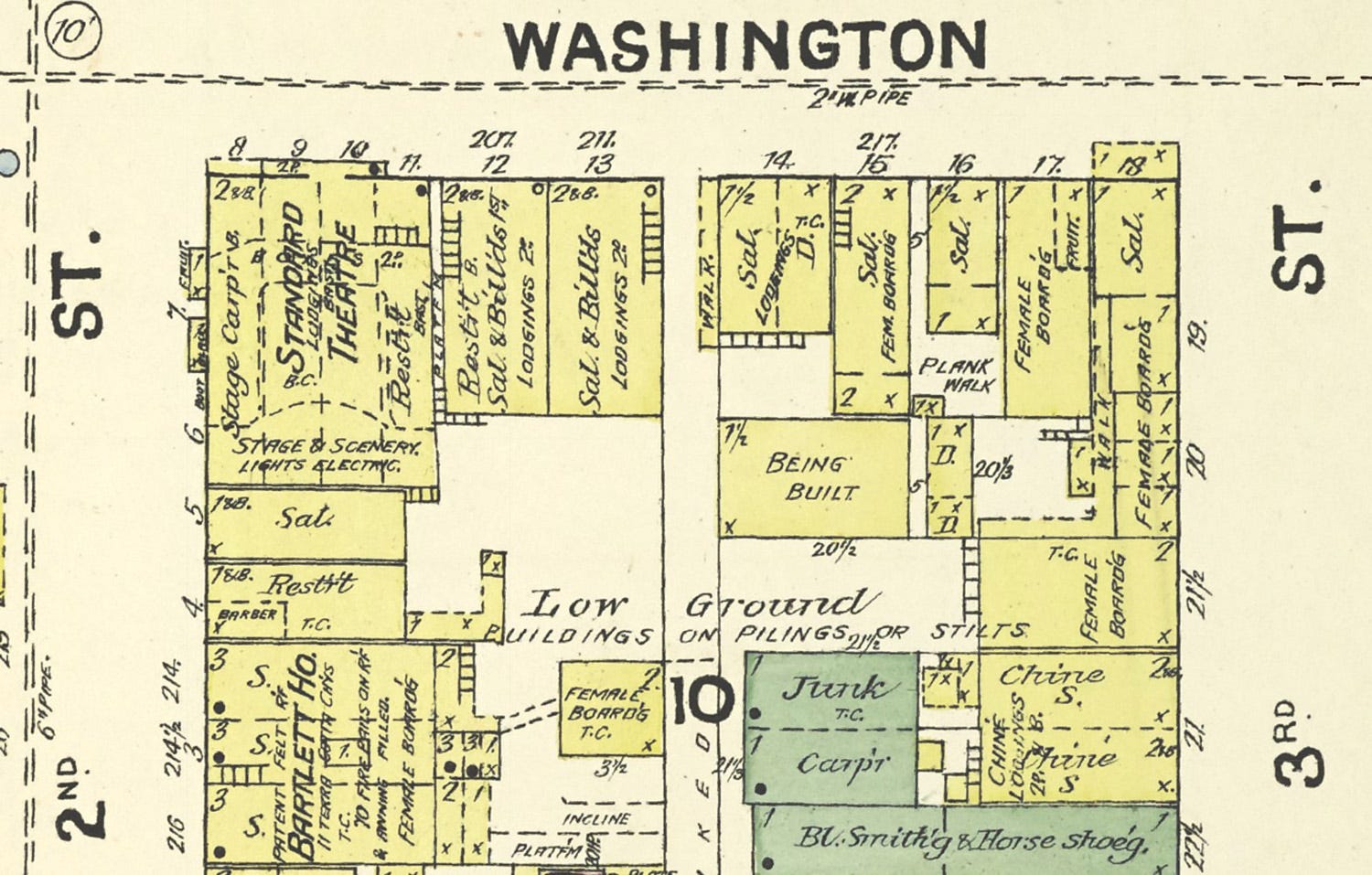
“Low Ground Buildings on Pilings or Stilts” noted on this detail from the 1888 Sanborn fire insurance map for Seattle.
Note the references to “Chine”, bottom right. Once Chinese immigrants began to arrive in Seattle starting in 1860, they were segregated into the least desirable part of Seattle, the Sawdust. The Theodore Peiser photograph shows Seattle’s original Chinatown. And note the references to female boarding houses, a euphemism for “resorts”, as brothels were called at the time. The Sawdust became Seattle’s Red Light District.
One more thing about Peiser’s photograph that I love. Note the two buildings just beyond the Oriental Hotel. You can clearly see that the buildings are tilting and sinking into the actual sawdust that underlay the Sawdust. Neither of the buildings survive on the 1888 Sanborn fire insurance map, where the Standard Theater is located.
Both fascinating, utterly, and heartbreaking re: what was lost to make our beloved city.